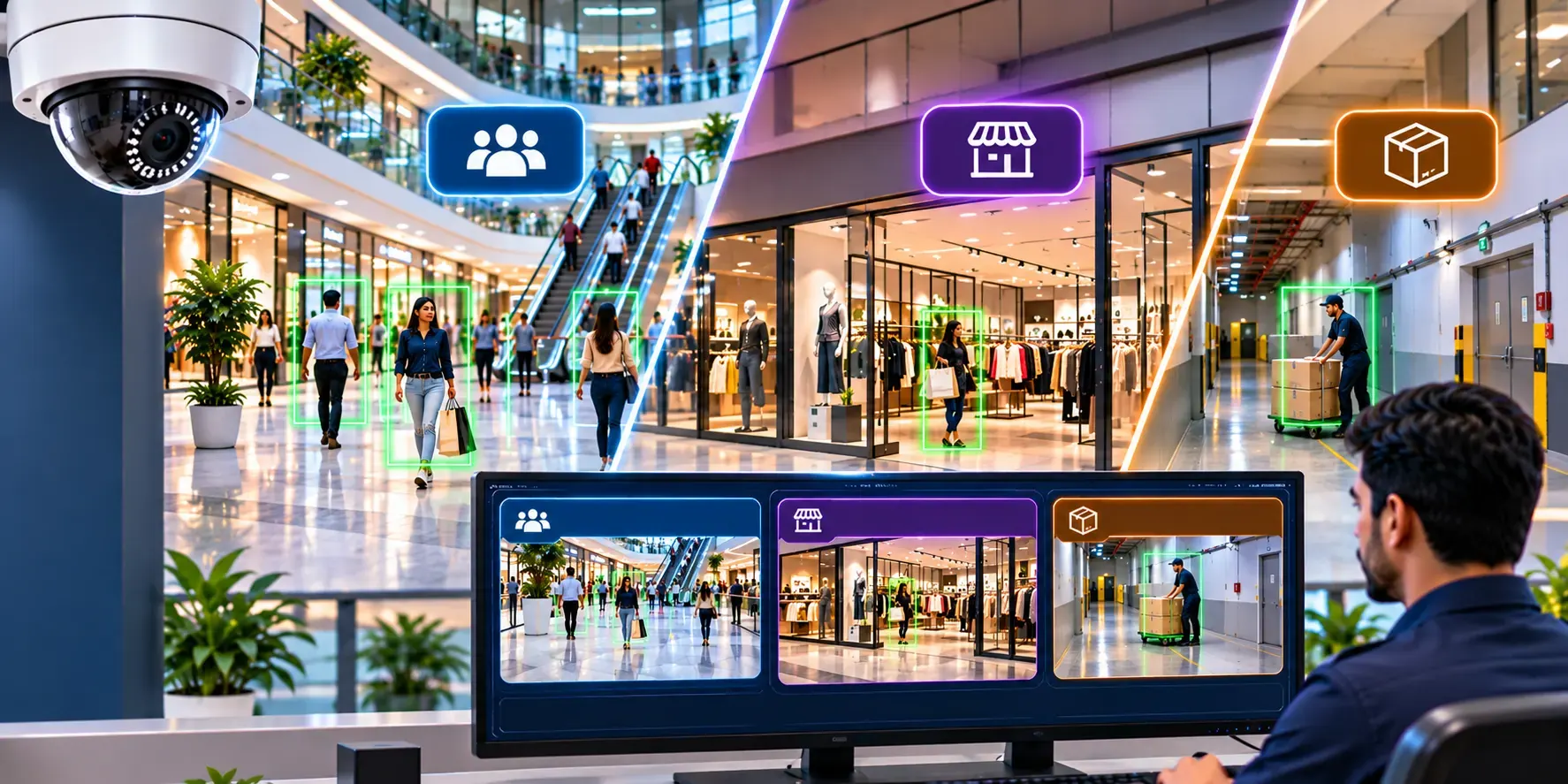
 AI Generated
A shopping mall is not one security problem. It is several, stacked on top of each other: public concourses with thousands of visitors, dozens of tenant stores with their own staff and stock, and a hidden service layer of loading docks, corridors, and storerooms that shoppers never see. A control room with a wall of monitors cannot watch all of it, and a single rule set cannot protect all of it.
This guide proposes a three-zone framework for applying AI surveillance across a mall, so each area gets the right rules, the right alert owner, and the right level of attention.
Why Mall Operators Are Under More Pressure
Malls are becoming more valuable and more crowded with expectations. Cushman & Wakefield reports that Grade A mall vacancy declined to 4.8% in Q3 2026, with around 12.7 million square feet of new Grade A mall supply expected through 2028. Malls are also growing in scale: CRE Matrix data reported by The Federal projects that the average size of new shopping malls will rise from 0.25 msf in the pre-2000 era to 0.59 msf during 2026-30.
For a mall management team, tight vacancy raises the cost of any incident that damages a tenant’s confidence or a visitor’s experience. Larger floor plates mean more corridors, more entrances, and more areas that no one is physically patrolling at a given moment. That is exactly where passive cameras fall short, a point also made in From Passive Recording to Active Intelligence.
The Three-Zone Framework
Zone 1: Public and common areas. Concourses, atriums, entrances, parking links, food courts, restroom corridors.
Zone 2: Tenant-facing interfaces. Shared service points between the mall and its stores, such as tenant entrances to service corridors, shared shutters, and common-area-facing storefront approaches.
Zone 3: Back-of-house. Loading docks, service lifts, goods corridors, storerooms, plant rooms, and staff-only passages.
Each zone has different risks, different owners, and different consequences when something is missed.
Zone 1: Common Areas, Where Alerts Must Be Selective
Common areas generate the most footage and the most potential noise. The goal is not to alert on everything that moves, but on exceptions your operations team has agreed on in advance.
Typical rule candidates, which CCTV Patrol can support through configurable alert rules:
- Loitering in areas that are normally pass-through
- Intrusion or access into closed or restricted zones after hours
- Suspicious after-hours activity in the concourse when the mall is shut
- Safety incidents that need a quick supervisor response
Keep the number of live rules small at first. A mall control room that receives constant low-value alerts will quickly learn to ignore all of them. This is the same discipline described in From Observe to Alert: detection is only useful if the right person acts on it.
Zone 2: The Mall–Tenant Interface
This is the zone most malls neglect, because responsibility is shared. Tenants control their own stores, but the mall controls shared corridors and entrances. A practical approach:
- Agree with tenants which shared-area cameras are covered by mall analytics and which stay with the tenant.
- Define what mall management will do when an alert concerns a tenant area, such as informing the tenant’s duty manager.
- Document this in tenant guidelines so alerts do not become disputes.
For tenants that run their own CCTV, a separate deployment on their own NVR can give them store-level monitoring. Chain tenants may like the idea of applying consistent rules across all their outlets, as described in Restaurant Video Analytics for food outlets.
Zone 3: Back-of-House, Where Value Is Highest
Service areas are quiet, lightly staffed, and rarely watched. They are also where deliveries, stock movement, and staff access converge. Rules here tend to be precise:
- Restricted-area access to storerooms, plant rooms, and service lifts
- After-hours movement in goods corridors and docks
- Unusual presence at loading areas outside delivery windows
- Staff-only passage use by unexpected individuals
Back-of-house rules give the clearest return because the baseline is predictable. If nobody should be in a corridor at 2 AM, any detection there is meaningful. The same logic of restricted-zone monitoring applies in industrial settings, covered in AI Surveillance for Manufacturing.
Mapping Zones to Alert Owners
| Zone | Typical alert owner | Response style |
|---|---|---|
| Common areas | Mall control room / security supervisor | Quick on-floor check |
| Tenant interface | Facilities or operations manager, tenant duty manager | Coordinated follow-up |
| Back-of-house | Security head and facilities | Immediate verification, logged |
CCTV Patrol delivers alerts through WhatsApp, email, mobile notifications, and a dashboard, so managers who are on the move can still respond. Daily reports then give a consolidated record of what happened across the property.
Sizing a Mall Deployment
Malls have large camera counts spread across big footprints. Compact devices suit small outlets, but mall-scale sites typically need server-class capacity. CCTV Patrol ELITE is described as an industrial AI processing server for 8+ cameras and large-scale deployments, positioned for campuses and corporate buildings among other sites. See the product variants. For malls with multiple towers or properties, multi-site monitoring from a single dashboard lets a central team see every location.
Because the platform connects to your existing NVR and IP cameras, you do not need to replace the cameras a mall has already installed.
Resilience Matters in Large Buildings
Malls run long hours and depend on building networks that tenants and vendors also use. CCTV Patrol supports internet-independent operation with on-premises video processing, so detection continues during outages and syncs afterwards. Test this in a pilot before relying on it.
A Mall Deployment Roadmap
- Map zones and cameras. Label every camera as Zone 1, 2, or 3.
- Pick 3 to 5 high-value rules per zone. Start with after-hours and restricted-area events.
- Pilot on one wing or one level for two weeks in observation mode.
- Assign owners and response times for each alert type.
- Agree tenant-interface protocols in writing.
- Review daily reports weekly, and refine thresholds.
- Expand by wing or property, keeping rule definitions consistent.
Privacy and Policy
Mall surveillance involves large numbers of visitors, so clarity matters. Publish what is monitored and why, limit alert access to defined roles, and take advice from your legal team on local obligations. Rule-based detection of events such as intrusion and loitering is a different thing from identifying individuals, so state clearly which one you are doing.
Conclusion
Malls need structure more than they need more screens. Divide the property into common areas, tenant interfaces, and back-of-house; give each zone a small set of meaningful rules; and route alerts to named owners. Done well, AI surveillance for shopping malls turns existing cameras into a coordinated safety and loss-prevention layer. To see how it could look on your property, request a demo.
FAQs
It connects to the mall’s existing CCTV, applies configured rules such as restricted-area access, loitering, and after-hours activity, and sends real-time alerts and daily reports.
No. CCTV Patrol works with existing CCTV NVRs and IP cameras.
Back-of-house corridors, loading docks, storerooms, and shared service areas often deliver the clearest value, followed by selective monitoring of common areas.
Agree in writing which cameras and alerts belong to the mall and which to the tenant, and define how alerts about tenant areas are communicated.
Yes. Multi-site monitoring lets one dashboard show alerts and reports from multiple locations.
Large-scale deployments with 8+ cameras typically need server-class capacity such as CCTV Patrol ELITE, subject to a site assessment.
Your cameras already see everything. Patrol makes them understand everything.
Transform surveillance footage into actionable intelligence. Receive real-time alerts, ensure SOP compliance, and protect people, assets, and reputation.