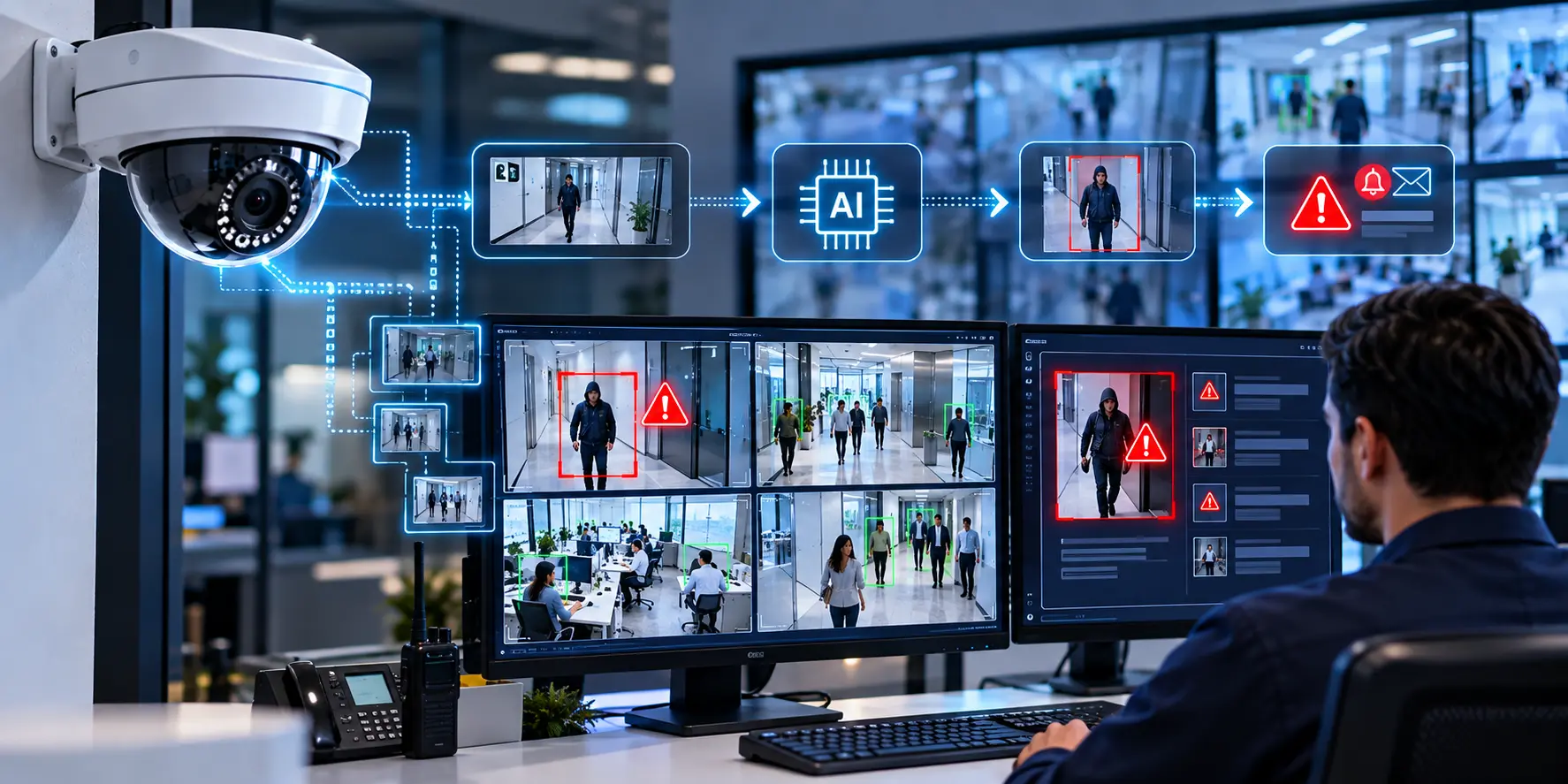
 AI Generated
Ask most business owners how their CCTV works, and the honest answer is: it records, and someone checks it if something goes wrong. That's not really a security process—it's a storage process. The actual shift happening across industries right now isn't about better cameras; it's about what happens to the footage after it's captured. Traditional CCTV only records. A modern AI surveillance system turns every camera into an active observer, running through a five-step cycle—Observe, Analyze, Detect, Report, Alert—that applies the same way whether it's watching a kitchen, a pharma cleanroom, a factory floor, or a retail counter.
Step 1: Observe—Watching Every Camera Feed, 24/7
The process starts with continuous observation across every connected camera, with no human required to sit and watch a monitor. This is the foundational difference from manual security: a person can watch one or two screens attentively for a limited stretch before attention drifts, but the system watches every feed simultaneously, around the clock, without fatigue. Whether it's a single billing counter in a restaurant or dozens of cameras across a manufacturing plant, this stage never stops.
Step 2: Analyze—AI Interprets What It Sees in Real Time
Raw footage on its own means nothing until it's interpreted. In this stage, the AI processes what's happening in each frame against the context of what it's supposed to be watching for—not just detecting movement, but understanding what that movement represents. This is what separates real analytics from a basic motion sensor, and it's the stage that makes industry-specific detection possible. The same underlying interpretation engine that powers Restaurant Video Analytics on a kitchen floor is the one applied to AI Surveillance for Pharma cleanrooms or a manufacturing production line—only the rules being interpreted against change per site, as detailed under Key Features.
Step 3: Detect—Flagging Events, Violations, and Anomalies
This is where interpretation becomes action. The moment something crosses a configured threshold—a PPE violation, an unauthorized entry, unusual after-hours movement, a pest sighting—the system flags it instantly. This stage isn't theoretical; it's been demonstrated directly. The Live Detection section shows two real, unstaged captures from an active kitchen: a staff member flagged for missing required headgear during a 2:51 AM SOP/PPE check and a rodent identified and boxed with 88% confidence during an 8:00 AM pest scan, even on low-light night-vision footage. That's Detect in practice—not a hypothetical capability, but a documented one.
The same detection logic scales across very different environments. AI Surveillance for Manufacturing applies it to PPE checks near heavy machinery and restricted-zone access around production equipment. AI Surveillance for Retail Stores applies it to loitering near high-value displays or unattended checkout counters. AI Surveillance for Pharma applies it to gowning compliance and restricted cleanroom access. The mechanism is identical; only the configured rule changes.
Step 4: Report—Logging and Summarizing Every Observation
Detection alone would leave a business drowning in isolated alerts with no way to see the bigger picture. This stage compiles every alert and observation into automated daily reports, giving management a structured, timestamped record rather than a pile of disconnected incident clips. For a business running multiple locations, this reporting layer feeds directly into a centralized management dashboard, where patterns become visible—a recurring hygiene lapse at one restaurant outlet, a repeated after-hours access attempt at one retail store—that a single incident review would never surface on its own.
This is also where video analytics in retail stores delivers value beyond loss prevention: reporting patterns across shifts and locations gives operations teams visibility into service consistency and staff conduct, not just security events.
Step 5: Alert—Notifying You the Moment It Matters
The final stage is the one that actually closes the loop between detection and response. Alerts reach the right person within seconds through WhatsApp, email, and the dashboard simultaneously, as outlined under Instant WhatsApp & Email Alerts. This is the practical difference between a system that documents a problem and one that helps prevent it from escalating—a theft caught in real time is a stopped theft; the same theft discovered a week later during a stock count is just a confirmed loss.
Why the Same Five Steps Work Across Every Industry
What makes this process genuinely scalable is that Observe, Analyze, Detect, Report, and Alert don't change from one industry to the next—only the configured rules inside them do. A restaurant configures rules around hygiene and till security to power restaurant video analytics. A pharmaceutical facility configures rules around cleanroom gowning and controlled-substance access for AI surveillance for Pharma. A factory configures rules around PPE and machinery zones for AI surveillance for manufacturing. A retail chain configures rules around checkout counters and stockrooms for AI surveillance for retail stores, applying the exact same video analytics in retail store logic across every outlet.
This consistency is also why deployment doesn't require new hardware. As detailed under How It Works, the system connects directly to an existing CCTV NVR, meaning the five-step process runs on top of camera infrastructure a business has already installed — the intelligence layer is what's new, not the cameras.
From Passive Recording to Proactive Prevention
The comparison under Why Choose CCTV Patrol makes the practical outcome of this five-step shift explicit: traditional CCTV only records events, relies on manual footage review, reacts after incidents, and needs high staffing effort to monitor. A system built around Observe, Analyze, Detect, Report, and Alert instead understands and interprets events, delivers real-time automated alerts, enables proactive prevention, and needs minimal supervision to run.
The Bottom Line
The gap between traditional CCTV and modern AI surveillance isn't about camera quality — it's about what happens in the moments after something is captured on film. Observe, Analyze, Detect, Report, Alert is the process that turns a passive recording device into an active system that actually protects a business, whether that business is a single restaurant kitchen or a multi-site pharmaceutical, manufacturing, or retail operation. Request a demo to see this five-step process configured around your own cameras and business rules.
FAQs
The process is Observe (continuous camera monitoring), Analyze (AI interprets what it sees), Detect (flags events and violations), Report (logs and summarizes observations), and Alert (notifies the right person in real time).
No. The system connects directly to an existing CCTV NVR, so the five-step intelligence layer runs on top of cameras already installed rather than requiring new hardware.
The underlying Observe-Analyze-Detect-Report-Alert cycle is identical across industries; only the configured rules change—hygiene and till security for restaurants and cleanroom and gowning compliance for pharma facilities.
Documented real-world detections include a staff PPE violation (missing headgear) flagged during a night-shift check and a rodent identified during a pest-activity scan, both flagged instantly rather than found during a later footage review.
Alerts are sent within seconds through WhatsApp, email, and a live dashboard simultaneously, rather than being discovered later during a scheduled footage review.
Your cameras already see everything. Patrol makes them understand everything.
Transform surveillance footage into actionable intelligence. Receive real-time alerts, ensure SOP compliance, and protect people, assets, and reputation.