 AI Generated
For decades, CCTV has meant one thing: a camera pointed at something, quietly recording, waiting for someone to either watch it live or dig through it after the fact. That model has never actually prevented anything—it only documents what already happened. The shift now underway isn't about adding more cameras or higher resolution. It's about giving the cameras already installed the ability to understand what they're seeing. That's the real distinction behind AI-powered CCTV Solutions that deliver real-time alerts, intelligent detection, and actionable insights instead of just footage.
The Core Shift: From Observer to Interpreter
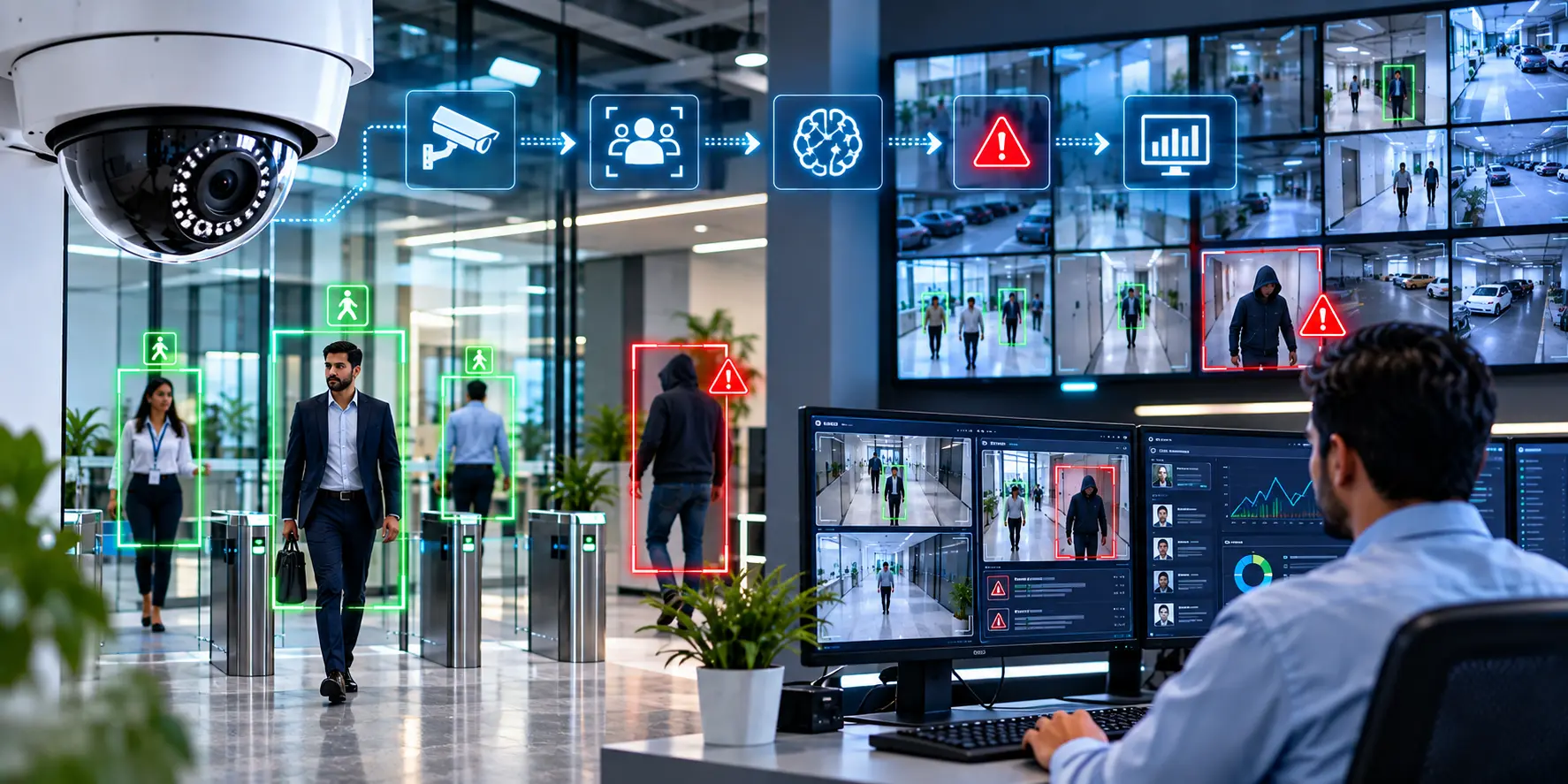
Traditional CCTV only records events. An AI video analytics platform does something fundamentally different—it observes continuously, analyzes what it sees against configured rules, detects the moment something matters, and reports and alerts accordingly. This five-stage cycle, laid out in The Shift and How It Works, is the actual mechanism behind "turning every camera into an active observer" rather than a passive recorder. The difference sounds subtle in a sentence, but operationally it's the gap between finding out about a problem during a scheduled review and finding out about it the moment it happens.
This is also why deployment doesn't require ripping out existing infrastructure. The platform connects directly to an existing CCTV NVR, meaning the intelligence layer sits on top of hardware a business has already paid for, rather than demanding a full camera replacement.
What "Intelligent Detection" Actually Means
The word "intelligent" gets used loosely in security marketing, so it's worth being specific. Intelligent detection here means the system doesn't just react to motion—it interprets context against rules a business defines itself: PPE and hygiene compliance, restricted-zone access, SOP violations, security breaches, and operational delays, all customizable per site under Key Features. That customization is what separates genuine detection from a generic motion-triggered camera that treats a falling leaf the same as an intruder.
Proof of this is easier to look at directly than to take on faith. The Live Detection section documents two real, unstaged captures from an active kitchen deployment—a staff PPE violation flagged automatically at 2:51 AM and a rodent identified and boxed with 88% confidence during a pest scan at 8:00 AM, captured on low-light, night-vision footage. Neither event required a human to be watching a monitor at that exact moment. That's the practical meaning of intelligent detection: catching what a tired night-shift reviewer would likely miss.
Real-Time Alerts: Closing the Gap Between Event and Response
Detection without a fast alert path is only half the value. The platform routes alerts through three simultaneous channels—WhatsApp, email, and dashboard—the moment a configured event occurs, as outlined under Instant WhatsApp & Email Alerts. This matters because the cost of most security and safety incidents scales with how long they go unnoticed. A theft caught in the first minute is a stopped theft; the same theft discovered during a weekly stock count is simply a documented loss.
Automated daily reports complement this by compiling every alert and observation into a structured summary, giving management a pattern of activity across shifts and locations—not just isolated incident clips reviewed in isolation.
Actionable Insights, Not Just Alerts
An alert tells you something happened. An insight tells you what to do about the pattern behind it. This is where Actionable Security Insights comes from, a centralized, cloud-based private dashboard, detailed under Cloud-Based Private Dashboard, where alerts, reports, and camera intelligence across every connected site are consolidated into one view. For a business running multiple locations, this centralized management—covered further under Centralized Management Control—turns individual alerts into visible trends: a recurring SOP lapse at one branch, a repeated after-hours access pattern at another, the kind of signal that's invisible when each incident is reviewed one clip at a time.
Edge AI CCTV and Why On-Premises Processing Matters
A genuinely reliable Edge AI CCTV deployment can't depend entirely on a live internet connection, because security incidents don't pause for network outages. The platform supports on-premises video processing, meaning detection and monitoring continue even when connectivity drops, with alerts and logs automatically synchronizing to the dashboard once the connection is restored, as detailed in the FAQ. This is a meaningful architectural distinction from cloud-dependent systems that go blind the moment the router does.
Scaling from a Single Site to an Enterprise Network
The same underlying AI surveillance system scales across very different deployment sizes. Under Product Variants, a compact device supporting up to 6–7 cameras is built for restaurants, retail stores, clinics, and small offices, while an industrial-grade processing unit supporting 8+ cameras and large-scale deployments serves manufacturing plants, pharma facilities, campuses, and corporate buildings. The comparison under Why Choose CCTV Patrol makes the underlying contrast explicit: traditional CCTV only records events and relies on manual footage review, reactive response after incidents, and high staffing effort for monitoring, while an AI-driven platform understands and interprets events, delivers real-time automated alerts, enables proactive prevention, and requires minimal supervision.
The Bottom Line
The value of AI-powered CCTV Solutions was never really about better cameras—it's about what happens between the moment something occurs and the moment someone finds out about it. Real-time alerts close that gap to seconds. Intelligent detection makes sure what gets flagged is actually relevant to the business's own rules, not generic motion. And actionable insights turn scattered incidents into patterns worth acting on. Together, that's the difference between a system that documents what went wrong and one that helps prevent it from going wrong in the first place. Request a demo to see how it applies to your existing camera setup.
FAQs
Traditional CCTV only records footage for later review. An AI-powered system continuously analyzes live feeds against configured rules, detects violations or events in real time, and sends instant alerts instead of relying on manual footage review after the fact.
It means detection is rule-based and customizable to a specific business—such as PPE compliance, restricted-zone access, or SOP violations—rather than generic motion-triggered alerts that can't distinguish context.
Alerts are sent through WhatsApp, email, and a live dashboard the moment a configured event is detected, rather than being discovered during a later, scheduled footage review.
Yes. On-premises video processing keeps detection and monitoring active during connectivity outages, automatically syncing alerts and logs to the dashboard once the connection is restored.
Yes. A compact device supports smaller sites like restaurants, retail stores, and small offices, while an industrial-grade processing unit handles large-scale deployments across manufacturing plants, pharma facilities, and corporate campuses.
Your cameras already see everything. Patrol makes them understand everything.
Transform surveillance footage into actionable intelligence. Receive real-time alerts, ensure SOP compliance, and protect people, assets, and reputation.