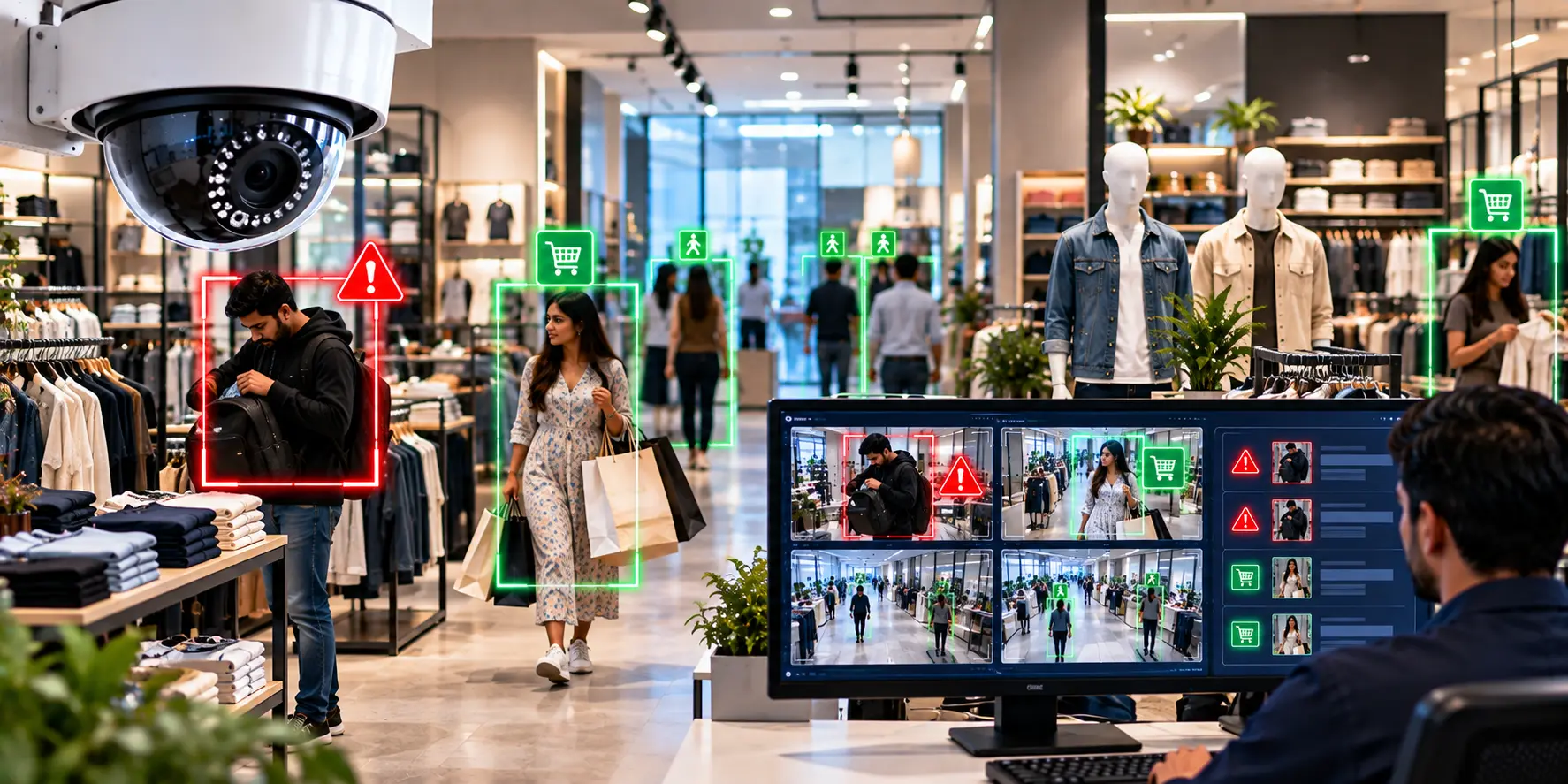
 AI Generated
Every restaurant already has cameras. Almost none of them are actually being watched. A manager reviewing footage after a customer complaint, a health inspector citing a hygiene lapse the owner never saw, a cash-register discrepancy discovered weeks later — these are symptoms of the same underlying problem: traditional CCTV only records. Nobody has time to sit and watch six kitchen cameras and four dining-area feeds across every shift, every outlet, every day.
Restaurant video analytics solves this by putting AI, not a human, in front of every camera feed — continuously, without fatigue, without gaps. Instead of footage that just sits on a hard drive until something goes wrong, the system actively interprets what it sees and tells you the moment something needs attention.
What Makes a Restaurant Security System "Smart"
A modern restaurant security system built on video analytics works fundamentally differently from a standard DVR/NVR setup. CCTV Patrol, for example, connects directly to a restaurant's existing CCTV NVR — no camera replacement required — and layers AI interpretation on top of the live feed through five steps: it observes every camera 24/7, analyzes what it sees in real time, detects predefined events or violations, logs and reports every observation, and alerts the right person the moment it matters. The alert itself is the differentiator — instead of discovering an issue during a monthly footage review, management gets notified in real time via WhatsApp, email, mobile notification, or a live dashboard.
This shift — from passive recording to active interpretation — is what separates traditional CCTV from true restaurant video analytics.
What Restaurant Video Analytics Actually Detects in a Kitchen
This isn't theoretical. Documented live detections from CCTV Patrol running in an actual restaurant kitchen include:
- PPE and SOP violations — the system tracks every person in frame and instantly flags a violation when a required item (like a hairnet or cap) is missing, alerting management within seconds rather than waiting for the next manual audit.
- Pest activity detection — the AI identifies object classes in real time (a rodent flagged with an 88% confidence score, for instance) and locks onto it the moment it enters frame, including in low-light, night-vision footage — catching a hygiene risk before it becomes a compliance failure or a customer-facing incident.
Beyond these two documented examples, the same underlying platform is built to detect intrusion and restricted-area access, general SOP non-compliance, loitering, suspicious after-hours activity, and safety incidents — all based on rules configured for each specific site, as outlined under Key Features.
Restaurant Video Surveillance Systems: What to Actually Monitor
Restaurant owners typically can't be physically present to watch every outlet, kitchen operation, employee action, hygiene practice, and customer interaction at once. That's the core challenge restaurant video surveillance systems with analytics are built to solve — coverage across:
- Kitchen hygiene and food safety — PPE compliance, pest activity, cleaning protocol adherence
- Staff SOP compliance — whether standard procedures are actually being followed, not just documented
- Customer service quality — visibility into front-of-house interactions across shifts
- Security and loss prevention — intrusion, restricted-area access, after-hours activity
- Multi-location oversight — a single dashboard covering every outlet in a chain, rather than separate systems per branch
The benefit isn't just catching problems — it's the operational visibility that comes from having every location observed consistently, using the same rules, without relying on staff to self-report or a manager to physically visit each site.
Restaurant Video Analytics Solutions: Two Deployment Options
Not every restaurant has the same camera count or scale, which is why CCTV Patrol offers two distinct restaurant video analytics solutions:
- Patrol EDGE — a compact AI surveillance device supporting up to 6–7 cameras, purpose-built for restaurants, retail stores, clinics, and small offices. It's designed to be cost-effective and easy to deploy — the right fit for a single outlet or a smaller kitchen operation.
- CCTV Patrol ELITE — an industrial-grade AI processing server supporting 8+ cameras and large-scale, multi-location deployments, aimed at operations like manufacturing plants and campuses but scalable to larger restaurant chains needing centralized, multi-site monitoring from one dashboard.
Both variants run on the same underlying AI platform — the difference is camera capacity and deployment scale, not detection capability.
Restaurant Security System Cost: What Actually Drives the Price
There's no single number that answers "restaurant security system cost" honestly, because the real cost depends on a handful of specific variables:
- Number of cameras and outlets — a single kitchen with 4–6 cameras (Patrol EDGE territory) costs meaningfully less to deploy than a multi-outlet chain needing centralized ELITE-level infrastructure.
- Existing CCTV infrastructure — because CCTV Patrol connects to your existing NVR and IP cameras rather than requiring new hardware, restaurants that already have a functioning camera setup avoid the largest cost component of a from-scratch security system.
- Number and complexity of alert rules configured — basic PPE/hygiene monitoring versus a fuller SOP-compliance rule set affects setup and configuration scope.
- Ongoing support level — deployment support typically spans consultation, AI alert configuration, integration, dashboard setup, training, remote technical support, preventive maintenance, and software updates.
Because pricing depends on outlet count, camera count, and which of these are already in place, the accurate way to get a restaurant security system cost figure for your specific operation is a direct consultation and demo rather than a generic online quote.
Why Restaurants Specifically Benefit From This Approach
Restaurants sit at an unusual intersection: they need security in the traditional sense (theft, intrusion, after-hours activity) and operational/compliance monitoring that most other retail businesses don't (food hygiene, PPE, pest activity, SOP adherence) — often across multiple outlets an owner can't physically visit every day. A system built specifically to prevent theft, monitor operations, and ensure safety in this environment does more than a generic security camera setup; it turns the same camera investment into a hygiene auditor, a compliance monitor, and a security system simultaneously.
FAQs
Restaurant video analytics uses AI to actively interpret CCTV footage in real time — detecting events like PPE violations, hygiene issues, pest activity, or security breaches — instead of just recording footage for later manual review.
No. Systems like CCTV Patrol connect directly to your existing CCTV NVR and IP cameras, adding AI analysis on top of your current setup without requiring hardware replacement.
Documented detections include PPE and SOP violations (such as missing required kitchen headwear) and pest activity (such as a rodent identified and flagged in real time), alongside intrusion, restricted-area access, loitering, and after-hours activity.
Alerts are delivered in real time via WhatsApp, email, mobile notifications, and a live dashboard, along with automated daily reports summarizing all incidents and observations.
A compact device supporting 6–7 cameras suits a single restaurant or small kitchen, while an industrial-grade processing server supporting 8+ cameras is built for multi-outlet chains needing centralized, multi-site monitoring from one dashboard.
Cost depends on the number of cameras and outlets, whether you already have compatible CCTV infrastructure in place, and how many alert rules you need configured — since systems that connect to existing cameras avoid the largest cost of a from-scratch install, a direct consultation is the accurate way to get pricing for your specific setup.
Yes — on-premises video processing means monitoring continues during outages, with alerts and logs automatically synchronized once connectivity is restored.
Yes, multi-site monitoring allows all outlets, branches, or kitchens to be monitored from a single centralized dashboard rather than requiring separate systems per location.
Both — the same platform is configured to handle security concerns (intrusion, theft, after-hours activity) alongside operational and compliance monitoring (PPE, hygiene, pest activity, SOP adherence), which is specific to how restaurants operate compared to general retail security.
Traditional CCTV only records footage for manual review after an incident. AI video analytics continuously interprets the live feed, flags violations or anomalies as they happen, and sends real-time alerts — shifting security from reactive to proactive.
Your cameras already see everything. Patrol makes them understand everything.
Transform surveillance footage into actionable intelligence. Receive real-time alerts, ensure SOP compliance, and protect people, assets, and reputation.