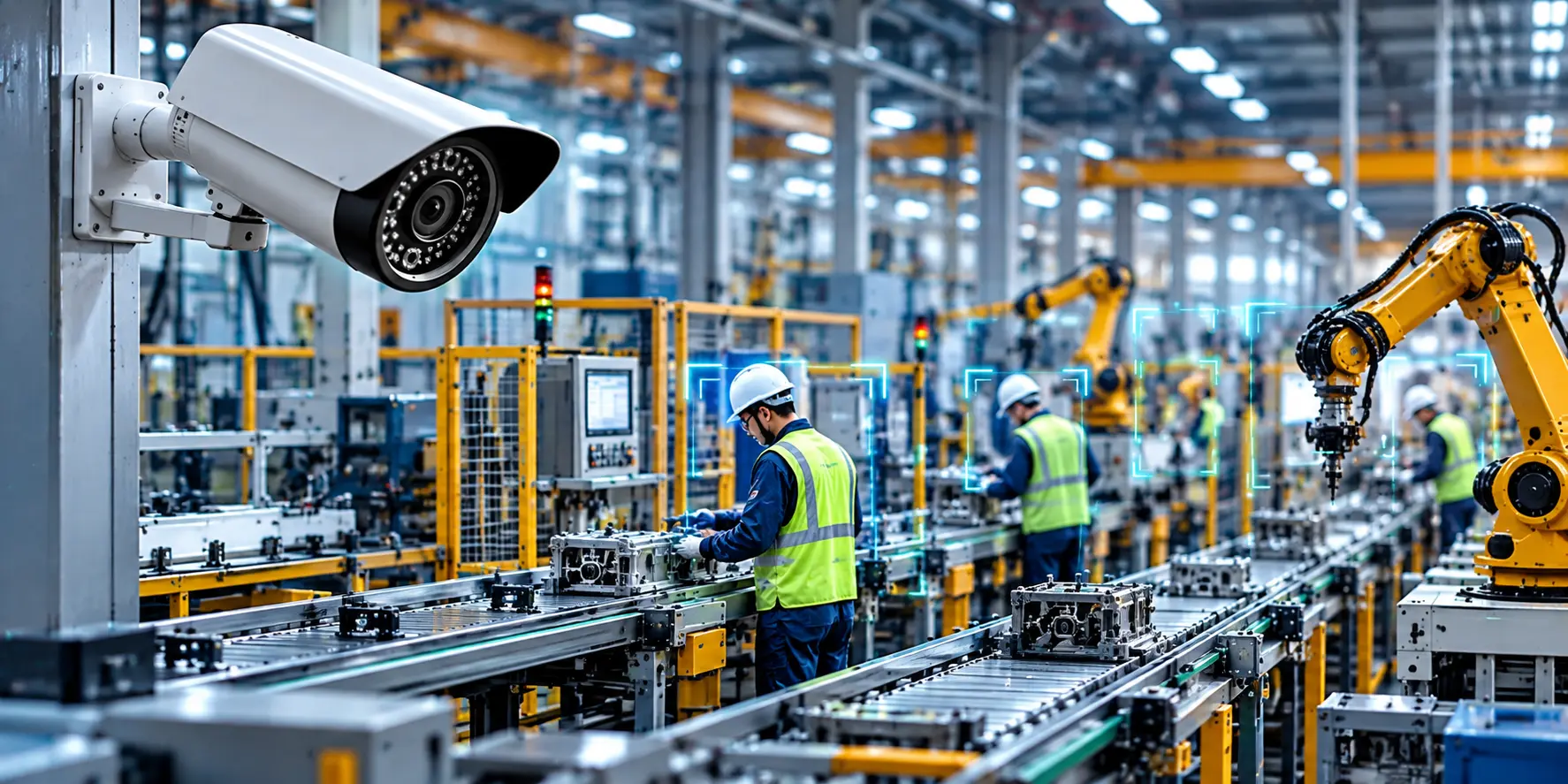
 AI Generated
Manufacturing plants run on tight production schedules, heavy machinery, and large workforces moving across shop floors, warehouses, and loading docks simultaneously. In this environment, a single unnoticed safety lapse, an unauthorized presence near hazardous equipment, or a slowdown on the production line can carry real cost—in injuries, downtime, or lost output. Traditional CCTV, which only records footage for someone to review later, cannot catch these events as they happen. This is exactly why manufacturers are adopting AI surveillance for manufacturing—technology that actively interprets what's happening across every camera and reacts in real time, not after the fact.
Why Factories Are Moving Toward Smart Factory Surveillance
A typical plant floor combines high-value machinery, fast-moving material handling, and a large number of personnel working in shifts—a combination where manual monitoring simply cannot scale. Security guards and supervisors cannot watch every camera feed continuously, and reviewing hours of recorded footage after an incident does nothing to prevent the incident itself. This is the core idea behind Smart Factory Surveillance: instead of passively storing video, the system turns every connected camera into an active observer that flags deviations the instant they occur, following the connect-configure-monitor-detect-alert workflow outlined in How It Works.
This kind of AI security system for manufacturing plants connects directly into a facility's existing CCTV NVR and IP camera network, so manufacturers don't need to rip out and replace hardware they've already invested in—they simply add an intelligence layer on top of it.
How Manufacturing Video Analytics Protects the Shop Floor
At the core of any credible AI video analytics for manufacturing plants deployment is a continuous observe-analyze-detect-alert loop running across every camera on the plant floor, warehouse, and perimeter. The moment a configured rule is triggered—a worker entering a hazardous zone without required PPE, unauthorized access to a machinery bay, or unusual movement near restricted equipment—the system raises an immediate flag. The complete set of detection and alerting capabilities is outlined under Key Features.
Manufacturing video analytics in this context is fully customizable rather than relying on generic motion sensing. Safety helmet and PPE checks at entry points, restricted-zone rules around heavy machinery, and after-hours access controls on warehouse doors can each be configured as distinct detection scenarios—meaning the AI enforces a plant's actual safety protocols instead of a generic template. This same rule-based logic is what makes industrial video analytics effective across widely different production environments, from assembly lines to chemical processing units.
Protecting Employees Beyond Basic Security
The value of AI surveillance for industrial plants extends well beyond theft prevention. Employee safety is often the highest-stakes risk on a factory floor, and video-based intelligence gives safety officers visibility they cannot achieve by walking the floor themselves. Automated daily reports summarize every alert and observation across shifts, creating a documented, timestamped safety record—useful for internal review and for demonstrating proactive safety monitoring during audits or compliance checks.
For manufacturers running multiple production units or warehouses, centralized visibility matters just as much as detection itself. A multi-site management dashboard consolidates alerts, reports, and camera intelligence from every plant into a single interface, allowing a safety or security head to oversee several facilities through consistent factory AI monitoring without needing dedicated staff physically present at each one.
Monitoring Production and Preventing Threats
A well-configured AI security system for manufacturing plants is built to catch the risk categories that matter most on a production line: PPE and safety-gear violations near machinery, unauthorized entry into restricted production zones, loitering near high-value inventory or raw materials, and suspicious after-hours activity at loading docks or storage areas. Similar violation detection—including missing protective equipment flagged the instant it's identified—has already been demonstrated in real-world detection footage from an active industrial deployment, illustrating the same underlying detection logic that applies directly to factory floors and production lines.
Because manufacturing plants typically run extensive camera networks across multiple buildings, production lines, and storage yards, scale is a genuine requirement. An industrial-grade processing unit supporting 8+ cameras and large-scale deployments is positioned specifically for manufacturing plants, pharma facilities, and corporate campuses—making it the natural fit for enterprise-wide AI surveillance for manufacturing rather than the compact device suited to smaller retail or clinic environments.
Built for Round-the-Clock Reliability
Production doesn't stop, and neither should security monitoring. A dependable factory AI monitoring setup needs to keep functioning even when network connectivity drops. On-premises video processing ensures monitoring and detection continue uninterrupted during outages, with alerts and logs automatically synchronizing to the dashboard once the connection is restored. For a plant running multiple shifts around the clock, this internet-independent architecture means there's no monitoring gap, regardless of network conditions.
Alerts are delivered instantly through WhatsApp, email, and a private dashboard, so plant supervisors and safety officers are notified within seconds—not at the next shift handover—whenever a safety violation, security breach, or operational anomaly is detected.
The Bottom Line
Manufacturing environments cannot afford to treat security and safety monitoring as an after-the-fact exercise. Every unnoticed PPE violation, unauthorized zone entry, or production-line anomaly carries downstream consequences — for worker safety, output, and asset protection alike. Deploying AI Surveillance for Manufacturing through a properly configured Smart Factory Surveillance approach turns an existing camera network from a passive recording tool into an active safety and threat-detection system — protecting employees, monitoring production, and preventing threats exactly as a modern factory floor demands. Get in touch to discuss your plant's requirements and see how AI-driven video analytics can be configured around your specific operations.
FAQs
It continuously monitors for PPE and safety-gear violations, unauthorized entry into hazardous zones, and unsafe movement near machinery, sending instant alerts so supervisors can intervene before an incident occurs rather than reviewing it afterward.
It can detect missing protective equipment, restricted-zone intrusion near heavy machinery, loitering around high-value raw materials or inventory, and suspicious after-hours activity at warehouses or loading docks.
Yes. The system connects directly to existing CCTV NVR and IP cameras, allowing a plant to add AI-driven detection and alerting without replacing current surveillance hardware.
Yes. Industrial-grade AI processing units supporting 8+ cameras are built specifically for large-scale deployments across manufacturing plants and multi-site facilities, with centralized dashboard monitoring for every location.
Yes. On-premises video processing keeps detection and monitoring active during connectivity loss, automatically syncing alerts and reports once the network connection is restored.
Your cameras already see everything. Patrol makes them understand everything.
Transform surveillance footage into actionable intelligence. Receive real-time alerts, ensure SOP compliance, and protect people, assets, and reputation.