 AI Generated
Walk into a typical retail shop and you will find a familiar toolkit: a few cameras, maybe tag detectors at the door, a convex mirror in the corner, and a lock on the stockroom. Each device does one job. None of them tells the owner what is actually happening on the floor right now.
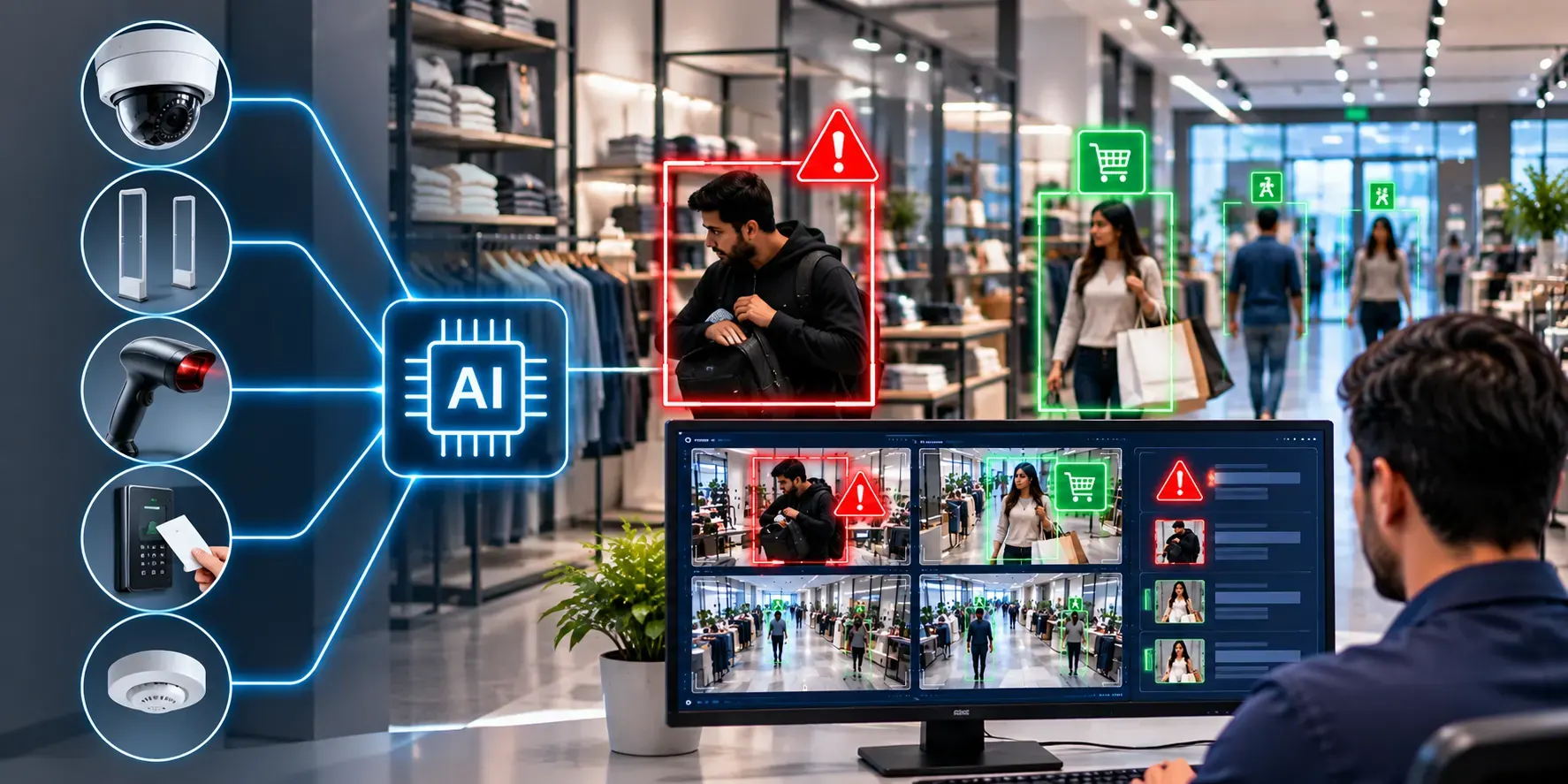
Buying more retail security devices rarely fixes that. What works is a layered design in which each layer has a defined role, and AI video analytics becomes the layer that connects the others. This guide shows how to build that stack.
The Threat Has Changed Shape
Losses are not only about someone slipping an item into a bag. NRF’s 2026 report found that shoplifting incidents fell 12.4% and merchandise theft fell 8.1% in 2025 compared with 2024, but also that external theft, fraud and scams continued to increase. Retailers surveyed reported higher rates of repeat offenders (50%), ORC-related incidents (40%), and walkout or pushout theft (37%).
Internal causes matter too. An NRF survey summarised by Michigan Public (based on 2022 figures) attributed about 36% of shrink to shoplifting and organized theft, 29% to theft by employees and 27% to mistakes in tracking, accounting or other errors. Those numbers are older, so treat them as a rough proportion rather than a current benchmark. The point stands: no single device addresses all three sources.
What Each Class of Security Device Actually Does
It helps to be honest about what each tool can and cannot do.
Deterrent devices (mirrors, signage, visible cameras, door chimes). They influence behaviour but gather no evidence and generate no alerts.
Tag-and-sensor systems (EAS gates, security tags). They react at the exit. By the time they sound, the item is already on its way out, and they do not capture who staff were serving or what happened at the counter.
Physical controls (locked cabinets, display cases, stockroom locks). Effective for high-value items, but they add friction for customers and staff, and a lock does not record who opened it or when.
Conventional CCTV. It records everything and interprets nothing. Its value arrives only after someone reviews footage, which is the problem described in From Passive Recording to Active Intelligence.
Each device is a point solution. What is missing is a layer that watches continuously and tells a human when something needs attention.
Where AI Video Analytics Fits
CCTV Patrol turns existing cameras into an active observer that follows a five-step loop of observe, analyse, detect, report, alert. Operators set the business rules, and the system sends alerts by WhatsApp, email, mobile, or dashboard when a predefined event occurs, with automated daily reports on top.
In a retail shop this means analytics works as the connective tissue:
- A tag gate triggers, and the camera footage for that moment is already time-stamped and logged.
- A restricted stockroom is entered after hours, and the owner is notified instead of discovering it in the morning.
- Counter activity is observed consistently across shifts, not only when a manager happens to be watching.
For how the detection-to-notification pipeline works under the hood, see From Observe to Alert: How AI Surveillance Actually Works Behind the Scenes.
A Four-Layer Retail Anti-Theft Stack
Layer 1: Deter. Visible cameras, signage, clear sightlines, and good lighting. Low cost, broad effect.
Layer 2: Delay. Locked display cases for high-value stock, controlled stockroom access, and tag systems at the exit. These slow down a thief and add decision time.
Layer 3: Detect. AI video analytics watches the floor, billing counter, stockroom, and back door against rules you define. This is the layer that converts passive cameras into retail video analytics solutions.
Layer 4: Document. Time-stamped alerts and daily reports create a record staff, managers, and owners can act on and refer back to.
Most small shops invest heavily in layers 1 and 2 and almost nothing in 3 and 4. That imbalance is where retail shop security solutions most often fall short.
Device-by-Device: What to Keep, Upgrade, or Add
| Existing item | Keep? | What analytics adds |
|---|---|---|
| Existing CCTV cameras and NVR | Yes | Interpretation and alerts on the same feeds |
| EAS gates / tags | Yes | Context for what happened around a trigger |
| Mirrors and signage | Yes | Nothing needed; they remain deterrents |
| Stockroom locks | Yes | Alerts for after-hours entry or unusual activity |
| Manual footage review | Reduce | Replaced by automated reports and alerts |
Because CCTV Patrol connects to your existing NVR and IP cameras, upgrading the detection layer does not require replacing hardware.
Choosing Rules That Match Real Retail Risk
Resist the urge to switch on every possible detection. Start with a short, high-value rule set:
- After-hours movement in stockroom or sales floor
- Back-door and staff-entry activity outside expected times
- Billing-counter observation against defined procedures
- Restricted-area access around high-value stock
- Loitering or unusual dwell near exits or valuable displays
CCTV Patrol supports customisable alert rules, so each shop can encode its own procedures instead of accepting a generic template. Run new rules in observation mode for a week or two, review the results with the store manager, and tighten before you turn on live paging.
Sizing for a Retail Shop
Most single stores and small chains fit the compact build. Patrol EDGE supports up to 6 to 7 cameras and is positioned for restaurants, retail stores, clinics, and small offices, while CCTV Patrol ELITE covers 8+ cameras and large-scale deployments. Both are described under product variants. Put analytics on the cameras that cover cash points, entrances, stockrooms, and high-value zones first.
Measuring Whether the Stack Works
Track a small set of metrics monthly:
- Alerts per week, and the share that were confirmed events
- Time from alert to staff response
- After-hours incidents detected versus discovered later
- Shrink movement by store, compared against your own baseline
- Hours of footage reviewed manually (this should fall)
Avoid claiming a specific percentage reduction until you have your own before-and-after data. Industry-wide numbers vary, and, as NRF’s own 2026 data shows, the type of loss shifts from year to year.
Conclusion
The best retail anti-theft security systems are not a single device. They are layers: deter, delay, detect, document. Most shops already own the first two. AI video analytics adds the third and fourth by making existing cameras watch continuously and report clearly. To see how that looks on your own cameras, request a demo.
FAQs
Cameras, EAS tags and gates, mirrors, alarms, and locked display cases. Each handles one task, so most shops combine several.
Usually, yes. Tags deter and trigger at the exit, while analytics adds continuous monitoring, alerts, and records. They work together.
No single device covers it. Controlled stockroom access plus video analytics for after-hours and back-door activity gives both prevention and evidence.
Yes. CCTV Patrol connects to your existing CCTV NVR and IP cameras.
CCTV Patrol sends real-time alerts via WhatsApp, email, mobile notifications, and a dashboard, with automated daily reports.
Start with cameras covering cash points, entrances, stockrooms, and high-value displays. A compact unit such as Patrol EDGE supports about 6 to 7 cameras.
Your cameras already see everything. Patrol makes them understand everything.
Transform surveillance footage into actionable intelligence. Receive real-time alerts, ensure SOP compliance, and protect people, assets, and reputation.