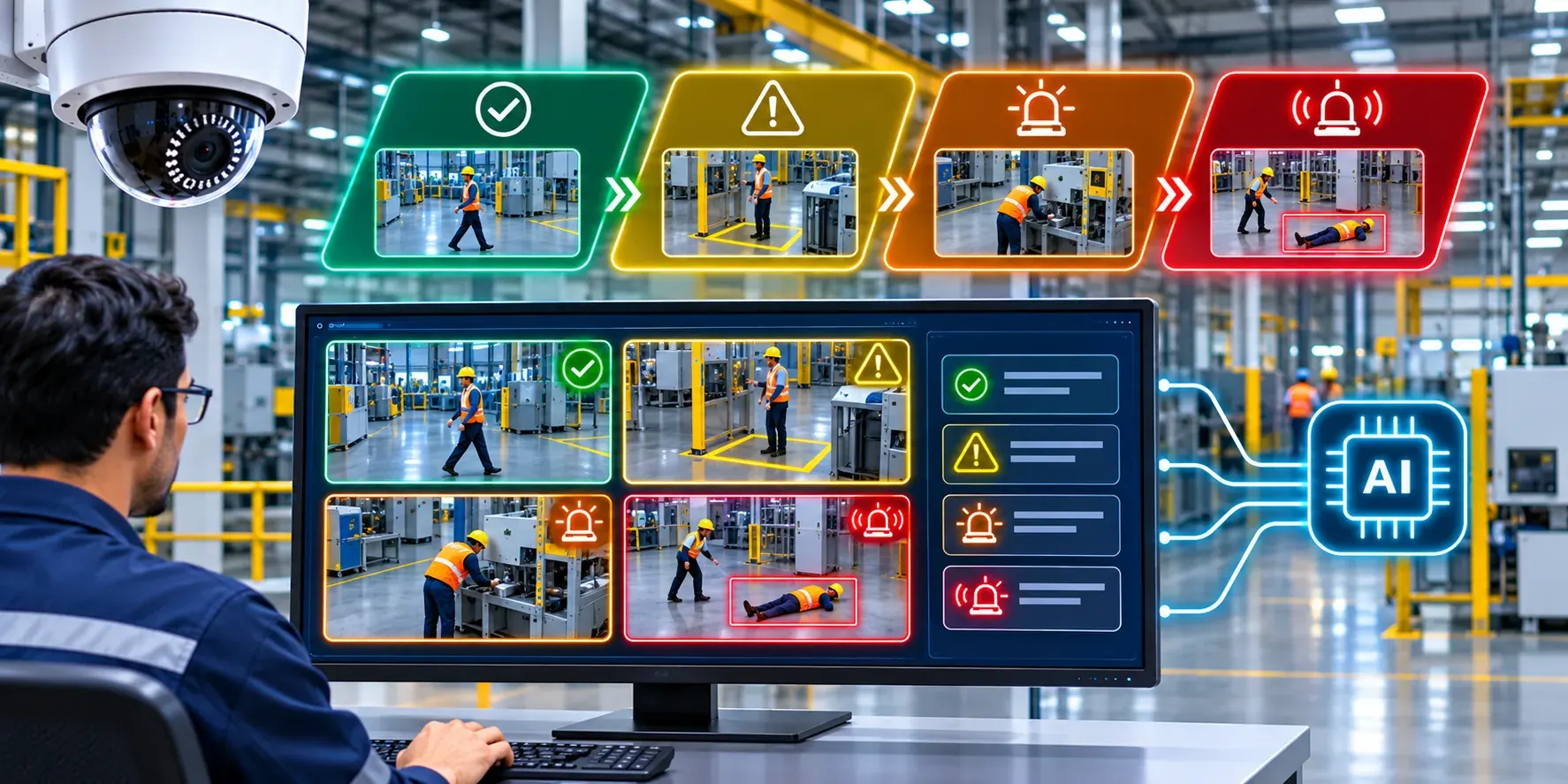
 AI Generated
The first question in most factory AI projects is “what can it detect?” The better question is “what should it tell us about, and how loudly?” A system that detects everything and pages everyone teaches a plant to ignore it. A system that is selective earns attention.
This guide gives plant heads and safety officers a practical way to sort events into alert tiers before configuring anything.
Why Selectivity Matters on a Factory Floor
Factories have real consequences for missed events. DGFASLI data, discussed in a Business Standard editorial, shows that registered factories reported 1,090 fatal injuries in 2023. Official figures cover registered factories only, so the true picture is wider. The practical lesson for monitoring design is that the events with the worst consequences must never be buried among minor notifications.
That is a design problem, not a detection problem. The pipeline from camera to person, covered in From Observe to Alert, only works if the person at the end can tell what matters.
The Alert-Worthiness Test: Five Questions
For each candidate event, answer five questions. They will place the event in the right tier.
- Severity. If this happens and nobody reacts, how bad is the worst realistic outcome? Injury, product loss, regulatory trouble, or minor inefficiency?
- Time to harm. How quickly does the situation get worse? A person without protective equipment next to moving machinery is a matter of seconds. A recurring delay at a packing station is a matter of shifts.
- Reversibility. Can the damage be undone? Irreversible outcomes (serious injury, contamination) deserve louder alerts.
- Actionability. Is there a specific person who can do something within the alert window? An alert nobody can act on is just noise.
- Verifiability. How clearly can the camera see the event? The clearer the evidence, the safer it is to page someone.
The Four Tiers
Tier 1: Page now. Immediate or irreversible harm, and someone can respond right away. Delivered through the fastest channel, to a small on-duty group, with a defined response time.
Tier 2: Notify this shift. Meaningful risk or violation that needs correction soon, but not instantly. Delivered to the line supervisor or shift in-charge.
Tier 3: Log and include in the daily report. Worth recording and reviewing, but not worth interrupting anyone. These appear in automated daily reports.
Tier 4: Trend only. Low-level observations that become useful only in aggregate, such as repeated minor delays at the same station across weeks.
CCTV Patrol supports this layered approach: alerts go out through WhatsApp, email, mobile, or dashboard, while automated daily reports capture the lower tiers. See the features overview.
Worked Examples for a Manufacturing Plant
The table below shows how the framework might classify common event types. Treat it as a starting draft to adapt per plant, not a fixed rule.
| Event | Severity | Time to harm | Suggested tier |
|---|---|---|---|
| Missing PPE in a defined high-risk zone | High | Seconds | Tier 1 |
| Entry into a restricted area after hours | High | Minutes | Tier 1 |
| Missing PPE in a low-risk walkway | Medium | Hours | Tier 2 |
| Loitering near a gate or storage area | Medium | Minutes to hours | Tier 2 |
| SOP deviation at a non-critical station | Low–Medium | Shift | Tier 2 or 3 |
| Repeated idle time or delay at a station | Low | Weeks | Tier 3 or 4 |
The homepage lists the event families CCTV Patrol can be configured for: PPE and hygiene violations, intrusion and restricted-area access, SOP non-compliance, loitering, suspicious after-hours activity, safety incidents, and operational delays. Confirm with the vendor how any other specific event, such as one tied to a particular machine, would be configured for your plant.
Make the Same Event Different in Different Zones
The same detection can sit in different tiers depending on where it occurs. Missing PPE is Tier 1 beside a press or furnace and Tier 2 in a corridor. After-hours movement is Tier 1 in a stores area holding valuable material, and Tier 3 in a canteen. Define tiers per zone and per shift, not per event type.
Shift-Aware Routing
Escalation should follow who is actually on site.
- Day shift: Alerts to line supervisors, with safety officer copied on Tier 1.
- Night shift: Fewer people on site, so Tier 1 alerts need a clear fallback, such as the duty manager and security head.
- Weekends and holidays: Restricted-zone and intrusion events deserve a higher tier because the plant is meant to be quiet.
Document who receives what, and what happens if nobody acknowledges within the set time. For the multi-plant version of this question, a multi-site dashboard lets head office see the pattern without receiving every alert.
Tune With Data, Not Opinions
Start conservative and adjust using real results.
- Observation mode first. Run rules without live paging for one to two weeks.
- Review confirmed vs unconfirmed alerts with supervisors.
- Promote or demote events between tiers based on actual outcomes.
- Review monthly, especially after layout, shift, or process changes.
A rule that is constantly dismissed should be tuned or demoted. A Tier 3 event that keeps recurring may deserve promotion to Tier 2.
Sizing and Resilience Considerations
Tiering only works if monitoring stays on. CCTV Patrol supports internet-independent operation with on-premises video processing, so detection continues during outages and syncs afterwards. For plants, the ELITE class (8+ cameras, large-scale deployments) is the relevant tier, as described under product variants.
Link to the Broader Smart Factory Picture
Alert tiering is one piece of a smart factory approach. For the larger context of protecting employees, monitoring production, and preventing threats, read AI Surveillance for Manufacturing: A Smart Factory Approach.
A One-Page Setup Checklist
- List 10 to 15 candidate events across your plant.
- Score each on severity, time to harm, reversibility, actionability, and verifiability.
- Assign each event a tier, per zone.
- Name an owner and a response time for every Tier 1 and Tier 2 event.
- Choose channels: fast channels for Tier 1, reports for Tier 3.
- Run in observation mode, then go live in stages.
- Review tiers monthly.
Conclusion
Factory AI monitoring is most useful when it is selective. Scoring events on severity, speed, reversibility, actionability, and verifiability turns a long list of detections into a short list of alerts people will actually act on. To see how this could map to your own cameras and zones, request a demo.
FAQs
Events with high severity and short time to harm, such as missing PPE in high-risk zones or entry into restricted areas after hours.
Use tiers. Page only for urgent events, notify supervisors for moderate ones, and push the rest into daily reports.
CCTV Patrol can be configured for operational delays among other event types. Confirm the exact setup for your stations in a pilot.
Yes. Routing and tiers should reflect who is on site and what is normal for that time.
No. CCTV Patrol connects to your existing NVR and IP cameras.
Monthly at first, and whenever processes, layouts, or shift patterns change.
Your cameras already see everything. Patrol makes them understand everything.
Transform surveillance footage into actionable intelligence. Receive real-time alerts, ensure SOP compliance, and protect people, assets, and reputation.