 AI Generated
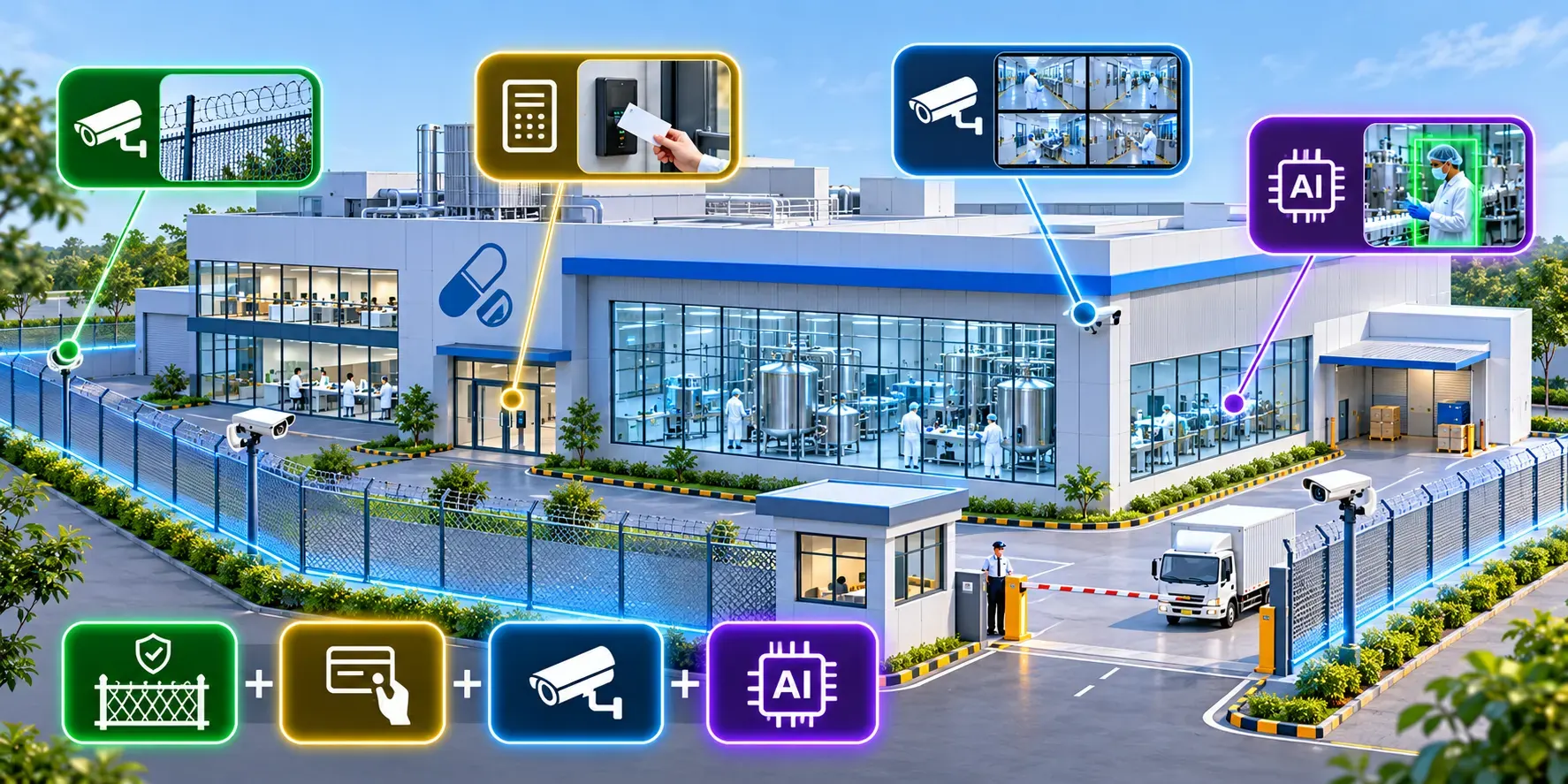
Most pharmaceutical plants already own several security components: a boundary wall and gate, an access control system, CCTV, and a guard force. Each works. The weakness lies between them: the door that was opened legitimately and then held for someone else, the contractor who badged in to one area and wandered into another, the camera that recorded it all and was watched by no one.
A good pharma security system is not a longer list of equipment. It is a set of layers designed so that each one covers the blind spots of the others. This guide shows how to build that.
Why Pharma Needs Layered Security
The threats are real and wide-ranging. The Pharmaceutical Security Institute reports that global law enforcement agencies uncovered 6,424 incidents of pharmaceutical counterfeiting, illegal diversion and theft of pharmaceuticals impacting 136 countries in 2024 (source). A BioPharma survey released in January 2025 found that pharmaceutical executives are near unanimous, with 68% strongly agreeing and 31% somewhat agreeing, in their concern about a marked increase in theft, fraud, and/or attacks in the pharmaceutical supply chain.
Those figures span the whole supply chain, not only plants. But a manufacturing site is where product, materials, formulations, and records are concentrated, which makes it a natural point of control. For the plant-level view, see AI Surveillance for Pharmaceutical Manufacturing.
The Five Layers
Layer 1: Perimeter. Boundary, gates, lighting, vehicle checks. Purpose: control what enters the site.
Layer 2: Access control. Badges, biometrics, visitor management, zone permissions. Purpose: decide who may enter which area.
Layer 3: Observation. CCTV across zones, with AI video analytics watching continuously. Purpose: see what actually happens, in real time.
Layer 4: Response. Guards, supervisors, and an escalation path. Purpose: turn detection into action.
Layer 5: Record. Alerts, logs, and daily summaries. Purpose: show what happened and what was done.
Layer 3 is the one most plants under-use, and it is the layer that ties the others together.
Where the Gaps Appear
Walk through your plant and ask what each layer cannot see.
| Gap | Why it happens |
|---|---|
| Access granted, then misused | Access control confirms identity at a door, not behaviour afterwards |
| Wrong person in the wrong area | Permissions are set per card, but movement inside a zone is unmonitored |
| After-hours activity | Guards patrol, but cannot watch every corridor continuously |
| Recording nobody reviews | CCTV stores footage, and review happens only after an incident |
| No evidence trail for near-misses | Events that never became incidents leave no record |
AI video analytics addresses most of these because it observes continuously and reports exceptions. CCTV Patrol follows an observe, analyse, detect, report, alert loop on your existing camera feeds, and its configurable rules cover restricted-area access, suspicious after-hours activity, loitering, and SOP non-compliance among other event types.
Layer-by-Layer Role of Analytics
At the perimeter. Cameras covering gates and boundary lines can alert on after-hours entry or loitering near entry points, supporting the guard force rather than replacing it.
At access points. Analytics can flag unusual presence at restricted doors or zones. Whether it can cross-reference your access control logs is an integration question to raise with the vendor. Do not assume it.
Inside production and storage areas. This is where rules tied to SOPs matter most: PPE and hygiene compliance, restricted-zone presence, after-hours movement around storage.
In the response layer. Alerts reach responders through WhatsApp, email, mobile, and a dashboard, so the right person knows quickly. The mechanics of that pipeline are explained in From Observe to Alert.
In the record layer. Automated daily reports summarise alerts, incidents, and observations, giving quality and security teams a consistent trail.
Design Principle 1: Zone First, Technology Second
Classify areas by sensitivity before choosing tools.
- Zone A (critical): Production suites, formulation, sterile areas, high-value storage. Highest scrutiny, tightest rules.
- Zone B (controlled): Packaging, QC labs, warehouse, dispatch. Moderate scrutiny.
- Zone C (general): Offices, canteen, car park. Basic monitoring.
Apply analytics rules heavily in Zone A, selectively in Zone B, and lightly in Zone C. This keeps alert volume manageable and focuses attention on what matters.
Design Principle 2: Make Layers Reinforce, Not Duplicate
Avoid buying overlapping tools that solve the same problem. Instead, ask of each addition: what gap does it close that the others do not?
- Another guard at the gate closes a perimeter gap, not an internal one.
- A stricter badge policy closes an access gap, not a behaviour gap.
- AI analytics on existing cameras closes the “watching” gap across all zones without new cabling.
Because CCTV Patrol connects to your existing NVR and IP cameras, it adds the observation layer without replacing what you already have.
Design Principle 3: Plan for Failure
Security layers fail, and good design assumes it. If the network drops, does observation continue? CCTV Patrol supports internet-independent operation with on-premises video processing and synchronises alerts and logs when the connection returns. Test this in a pilot. Also plan power backup for the edge device and NVR, so a short grid interruption does not create a blind spot.
Design Principle 4: Respect People and Policy
Pharma plants employ many staff and contractors. State clearly what is monitored and why, restrict access to alerts and reports to defined roles, and take advice from your legal and HR teams on local obligations. Staff are more accepting of monitoring when its purpose is safety and compliance, and when it is applied consistently.
Sizing the Observation Layer
Plants with many cameras typically need server-class capacity. CCTV Patrol ELITE supports 8+ cameras and large-scale deployments, with pharma facilities named among its intended sites (see product variants). Multi-plant groups can view sites through one centralised dashboard.
A Four-Step Implementation Path
- Map the gaps. Walk each zone with security, QA, and operations, listing what is not currently seen.
- Prioritise Zone A. Select 3 to 5 rules for critical zones, such as restricted access and after-hours movement.
- Pilot for two to four weeks in observation mode, then live, with named alert owners.
- Review monthly. Add rules only where a real gap or recurring issue justifies them.
Conclusion
A pharma security system is only as strong as the spaces between its layers. Perimeter and access control decide who gets in, but continuous observation tells you what happens next, and records prove it. Adding AI analytics to the cameras you already have is one of the most direct ways to close that gap. To see how this could look in your plant, request a demo.
FAQs
Perimeter control, access control, observation through CCTV and analytics, response, and record-keeping.
It watches camera feeds continuously and alerts on defined events, such as restricted-area access or after-hours activity, instead of relying on someone reviewing footage later.
No. It complements them by covering the gaps between access events and guard patrols.
That depends on the systems involved. Ask the vendor specifically about integration before assuming it.
No. CCTV Patrol works with existing NVR and IP cameras.
CCTV Patrol supports on-premises processing and syncs alerts and logs once connectivity is restored.
Your cameras already see everything. Patrol makes them understand everything.
Transform surveillance footage into actionable intelligence. Receive real-time alerts, ensure SOP compliance, and protect people, assets, and reputation.